



Questions in this chapter
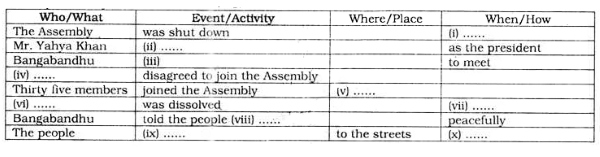
2. Read the following text and complete the table below with the given information:
I declared that the Assembly would continue to meet. But suddenly on the 1st of March the Assembly was shut down. Mr Yahya Khan called the session of the Assembly in his capacity as the President and I declared I would be attending it. Mr. Bhutto said he wouldn’t be part of it. Thirty-five members of the Assembly came from West Pakistan to take part in its proceedings. But it was dissolved all of a sudden. The blame was put on the people of Bengal, the finger was pointed at me! After the Assembly’s session was prorogued, the people of this country protested. I told them, “Observe the General Strike we have called peacefully.” I told them” Shut down all mills and factories.” Our people responded to my call. They came to the streets spontaneously. They expressed their firm determination to carry out the struggle peacefully. What have we got in return? Those who brought arms with our money to defend us from external enemies.
They are now using those arms on the poor- the wretched.- the downtrodden people of the land. Bullets are being aimed at their hearts. We constitute the majority in Pakistan: but whenever we Bengalis have tried to assume power they have used force on us.
3. Summarize the following text.
Accessibility to higher education implies that students get the opportunity to get university education and sufficient support from educational institutions. Increasing enrollment at the secondary and higher secondary level puts pressure on higher educational institutions. But due to limited capacity, only a small number of students may be enrolled in universities. Thus, each year a large number of students are denied access to higher education. Also, due to poverty and increase in educational expenses, students of the lower middle class do not get easy access to higher education. Moreover, those who get places in the universities have limited access to avail all kinds of diversified educational facilities relating to their study fields. Only about 12 percent of graduates enter higher educational institutions. More than 80 percent of these students are admitted to NU affiliated colleges. Others are absorbed by the public and private universities.
1. Read the passage and answer the questions A and B
One of the sources of water in our country are the rivers. Rivers are everywhere in our life, literature, economy and culture. But are the rivers in good shape? Unfortunately, they are not. A few are already dead and several are going through the pangs of death. The river Buriganga is an example of a dying river. A report published in the Daily Sun describes what has happened to the river Buriganga and why. It’s water is polluted and a perpetual stench fills the air around it. But that is not what it was like before. The report says that the river had a glorious past. Once it was a tributary of the mighty Ganges and flowed into the Bay of Bengal through the river Dhaleshwari. Gradually, it lost its link with the Ganges and got the name Buriganga. The Mughals marveled at the tide level of the Buriganga and founded their capital Jahangirnagar on its banks in 1610. The river supplied drinking water and supported trade and commerce. Jahangirnagar was renamed Dhaka which grew into a heavily populated city with a chronic shortage of space. The city paid back the bounty of the river by sucking life out of it! According to newspaper report, the Buriganga is dying because of pollution. Huge quantities of toxic chemicals and wastes from mills and factories, hospitals and clinics and households and other establishments are dumped into the river everyday. The city of Dhaka discharges about 4500 tons of solid waste everyday and most of it is directly released into the Buriganga. According to the Department of the Environment (DoE), 20.000 tons of tannery waste, including some highly toxic materials, are released into the river everyday. Experts identified nine industrial areas in and around the capital city as the primary sources of river pollution: Tongi, Tejgaon, Hazaribagh, Tarabo, Narayanganj, Savar, Gazipur, Dhaka Export Processing Zone and Ghorashal.
Choose the correct answer from the alternatives.
a. What could be the closest meaning for ‘shape’?
(i) Condition
(ii) Form
(iii) Model
(iv) Body
b. Which one of the following statements is false?
(i) The rivers are the only sources of water in our country.
(ii) The tide-level of the Buriganga was surprising.
(iii) It was connected with the river Dhaleshwari.
(iv) The humans are responsible for pollution.
c. How are the rivers related to ‘literature”?
(i) are being polluted
(ii) are a very important water source
(iii) can inspire the poets, novelists, etc.
(iv) constitute two-thirds of our country
d. Buriganga is on deathbed due to –
(i) water vehicles
(ii) pollutions
(iii) the Mughals
(iv) the report published in the newspaper
e. The Buriganga ---– the Ganges.
(i) has a link with
(ii) has nothing to do with
(iii) was a branch of
(iv) was once called
Answer the following questions.
(a) Do you think rivers attract people to urbanization? How?
(b) In what sense rivers are going through the pangs of death?
(c) What should we do to bring back the glorious past of the rivers?
(d) Do you think industrialization is responsible for river pollution?
(e) We, the people are responsible for the catastrophe of our rivers. Do you agree? Why/why not?
2. Read the following text and make a flow chart showing important aspects of craftwork. (No. 1 has been done for you)
A craftwork is an applied form of art, a social and cultural product reflecting the inclusive nature of folk imagination. A craftwork, which usually doesn’t bear the signature of its maker, retains a personal touch. When we look at a thirty year old nakshikantha we wonder at its motifs and designs that point to the artistic ingenuity and the presence of the maker in it. The fact that we don’t know her name or any other details about her doesn’t take anything away from our appreciation of the artist. Indeed, the intimate nature of the kantha and tactile feeling it generates animate the work and make it very inviting. A craftwork is shaped by the interaction of individual creativity and community aesthetics, utility functions and human values. It is distinguished by its maker’s desire to locate himself or herself in the wider and ever-changing cultural aspirations of the community and subsequently of the market.
3. Summarize the following text.
“I’m not in the least hungry,” my guest sighed, “but if you insist I don’t mind having some asparagus.” I ordered them. “Aren’t you going to have any?” “No, I never eat asparagus.” “I know there are people who don’t like them. The fact is, you ruin your palate by all the meat you eat.” We waited for the asparagus to be cooked. Panic seized me. It was not a question now of how much money I should have left over the rest of the month, but whether I had enough to pay the bill.
1. Read the passage and answer the questions A and B
Kuakata, locally known as Sagar Kannya (Daughter of the Sea) is a rare scenic spot located on the southern-most tip of Bangladesh. It is 70 km from Patuakhali district headquarters and 320 km from Dhaka. An excellent combination of the picturesque natural beauty, sandy beaches, blue sky and the shimmering expanse of water of the Bay of Bengal and the evergreen forest makes Kuakata a much sought after tourist destination. The name Kuakata takes its origin from the story of a ‘Kua’-or well-dug on the seashore by the early Rakhaine settlers for collecting drinking water. The Rakhaines had landed on Kuakata coast after being expelled from Arakan by the Mughals. Kuakata is one of the unique spots which allow a visitor to watch both the sunrise and the sunset from the beach. That perhaps makes Kuakata one of the world’s most attractive beaches. Kuakata is truly a virgin beach and a sanctuary for migratory winter birds. Fishing boats plying in the Bay of Bengal with colorful sails, surfing waves and the lines of coconut trees add to the vibrant colours of Kuakata. The indigenous cultures of the Rakhaine community and hundred year old Buddhist temples indicate the age-old tradition and cultural heritage of this area.
Choose the correct answer from the alternatives.
a. ‘Scenic spot’ refers to
(i) a place having multiple scenes
(ii) a place having a calm atmosphere
(iii) a place of unparalleled natural beauty
(iv) a place having untidy spots
b. The word 'shimmering' in the text could be best replaced by –---
(i) shivering
(ii) shining
(iii) significant
(iv) glaring
c. The Rakhaines originally came from -----
(i) Patuakhali district
(ii) Latachapli union
(iii) Kuakata coast
(iv) Arakan district
d. The best synonym of ‘vibrant’ is-----
(i) thrilling
(ii) colourful
(iii) gorgeous
(iv) brilliant
e. Kuakata is truly a virgin beach and a sanctuary for migratory winter bird’s – what does it imply?
(i) Kuakata is a beach in its original pure condition and a rare abode for guest birds.
(ii) Kuakata is a place of rare beauty and world’s longest beach.
(iii) Kuakata is untouched by human habitation
(iv) Kuakata is a natural habitat.
Answer the following questions.
(a) What does the expression ‘a much sought after tourist destination’ mean?
(b) Where does the name ‘Kuakata’ come from?
(c) What makes Kuakata an attractive tourist spot?
(d) Why would one visit Kuakata?
(e) ‘Kuakata’ upholds an ancient tradition how?
2. Read the following text and make a flow chart showing the situation of adolescent girls in Bangladesh. (No. 1 has been done for you)
In Bangladesh, the legal age of marriage for girls is 18. However, 33% of our girls get married before they are 15 and 60% of them become mothers by the time they reach 19. When an adolescent girl gets married. she usually drops out of school and thus loses her mobility. She gets confined to full-time work in her in-law’s household. She loses social status and all the opportunities of economic independence. In her in-law’s house, she gets marginalized. She becomes vulnerable to all sorts of abuse, including dowry-related violence. In our country, it is still a common practice for the bride’s family to pay dowry. Dowry demands can continue even after marriage. An adolescent bride, even if her in-laws are supportive, face enormous health risk during pregnancy a child birth. Majority of our people are uninformed or insufficiently informed about contraception and reproductive health. This leads to increased mortality rates among adolescent brides during childbirth.
3. Summarize the following text.
My name is Amerigo. I am 13 years old and I live on the street, alone. My mother, who is separated from my father, doesn’t want me. She told me to go away. Now she is married to another man. My father lives far away. I want to go to him, but he won’t take me either. The streets are now my home. Sometimes I find work. I used to collect trash and sell it to a vendor. I stopped doing that after I had a serious infection and a doctor told me to stay away from the trash dump. Once worked for an ice cream shop owner and sold ice cream on the beach. But I got no money in return. The owner of the shop gave me something to eat, and let me sleep in his hut at night. The work was difficult and painful. The ice-cream box was quite heavy when it was full. I had to walk for hours, offering my ice-cream to whoever wanted to buy. There were days when I could not even sell one ice-cream.
1. Read the passage and answer the questions A and B
The term ‘diaspora’ is used to refer to people who have left their homelands and settled in other parts of the world either because they were forced to do so or because they wanted to leave their own. The word is increasingly used for such people as a collective group and/ or a community. The world has seen many diasporas but scholars have been studying the phenomenon with great interest only in recent decades. Among the great diasporas of history is that of the Jewish people, who were forced to leave their lands in ancient times. The movement of Aryans from Central Europe to the Indian sub-continent thousands of years ago is also a noteworthy diaspora, although the causes of this diaspora are unclear. In twentieth century history, the Palestinian diaspora has attracted a lot of attention and been a cause of concern for world leaders because of the plight of Palestinians. There have been massive diasporas in Africa, too, over the centuries, either because of war or because of the ravages of nature. But the chief reason why the phenomenon of diaspora is attracting so much attention now is globalization.
Choose the correct answer from the alternatives.
a. The word ‘decade’ refers to –
(i) thirty year’s
(ii) fifty years
(iii) ten years
(iv) five years
b. What does diaspora mean?
(i) people live their own country
(ii) people go abroad
(iii) people work in other countries
(iv) people leave their own countries and settle in other parts of the world
c. The synonym of ‘noteworthy’ is ---
(i) insignificant
(ii) noticeable
(iii) invaluable
(iv) appreciable
d. The Aryans came to the Indian Sub Continent from -----
(i) America
(ii) Africa
(iii) Central Europe
(iv) Europe
e. In Africa there have been —
(i) massive diasporas
(ii) a little diasporas
(iii) no diasporas
(iv) very little diasporas
Answer the following questions :
(i) Why do people leave their own countries?
(ii) Do you think that there have been massive diasporas in Africa?
(iii) Why is diaspora attracting so much attention?
(iv) How do the twentieth century Palestinian diasporas draw the attention of the world leaders?
(v) Why have the scholars been studying about the diasporas with great interest?
2. Read the following text and make a flow chart showing role and activities of Gazi Pir. (No. 1 has been done for you)
According to some myths and legends, Gazi Pir was a Muslim saint who is said to have spread Islam in the parts of Bengal close to the Sundarbans. He was credited with many miracles. For example, he could supposedly calm dangerous animals and make them docile. He is usually depicted in paats or scroll paintings riding a fierce-looking Bengal tiger, a snake in his hand, but in no apparent danger. According to some stories, he also fought crocodiles who threatened the people of a region full of canals and creeks, indeed, a kind of watery jungle bordering the Bay of Bengal, Because of his alert and vigilant presence, all predatory animals were said to have been kept within bounds. It was also believed that he enabled villagers to live close to forests and jungles and cultivate their lands.
3. Summarize the following poem.
Because I have seen Bengal’s face I will seek no more;
The world has not anything more beautiful to show me.
Waking up in darkness, gazing at the fig tree,
I behold Dawn’s swallows roosting under huge umbrella — like leaves.
I look around me And discover a leafy dome-Jam, Kanthal, Bat, Hijol and Aswatha, trees –
All in a hush, shadowing clumps of cactus and zedoary bushes.
When long, long ago. Chand came in his honey combed boat
To a blue Hijol, Bat and Tamal shade near the Champa, he too sighted
Bengal’s in comparable beauty. One day, alas.
In the Ganguri, on a raft, as the waning moon sank on the rivers sandbanks.
1. Read the passage and answer the questions A and B
Folk music consists of songs and music of a community that are uninfluenced by any sophisticated musical rules or any standard music styles. Bangladesh has a heritage of rich folk music which includes both religious and secular songs. Folk music may be described as that type of ancient music which springs from the heart of a community, based on their natural style of expression uninfluenced by the rules of classical music and modern popular songs. Any mode or form created by the combination of tune, voice and dance may be described as music. Thus, the combination of folk song: folk dance and folk tune may be called folk music. For example, Baul songs are a combination of tune, music and dance. In Bangladesh folk music has great variety with songs being composed on the culture, festivals, views of life, natural beauty, rivers and rural and riverine life. These songs are also about social inequality and poverty, about the material world and the supernatural. Mystical songs have been composed metaphors of rivers and boats. Since the country is basically riverine, the Bhatiyali forms an important e or folk music. Folk music is formed and develops according to the environment. Differences in the natural environment are reflected in the people of the different regions. The dialects too vary across the different regions. Bangladeshi folk music therefore varies from region to region.
Choose the correct answer from the alternatives.
a. What could be the closest meaning for ‘sophisticated’?
(i) Latest
(ii) Old
(iii) Last
(iv) Past
b. The word ‘heritage’ refers to –---
(i) heir
(ii) tradition
(iii) legitimacy
(iv) intimacy
c. The word ‘natural’ could be replaced by –----
(i) artificial
(ii) spontaneous
(iii) deliberate
(iv) wanton
d. Folk music emanates from---- of a community.
(i) background
(ii) heart
(iii) core
(iv) inside
e. The synonym of ‘mystical’ is –----
(i) dull
(ii) material
(iii) classical
(iv) spiritual
Answer the following questions.
(a) What do you mean by folk music according to the text?
(b) What does folk music reflect?
(c) How are mystical songs composed of?
(d) What makes the Bhatiyali an important genre?
(e) What are the reasons of great variety in folk music?
2. Read the following text and make a flow chart showing the painful experiences a street child has to suffer to survive. (No. 1 has been done for you)
The streets are now my home. Sometimes I find work. I used to collect trash and sell it to a vendor. I stopped doing that after I had a serious infection and a doctor told me to stay away from the trash dump. Once I worked for an ice-cream shop owner and sold ice-cream on the beach. But I got no money in return. The owner of the shop gave me something to eat, and let me sleep in his hut at night. The work was difficult and painful. The ice-cream box is quite heavy when it is full. I had to walk for hours, offering my ice-cream to whoever wanted to buy. There were days when I could not even sell one ice-cream.
1. Homeless ---2----3----4----5----6
3. Summarize the following text.
Beauty is easy to appreciate but difficult to define. As we look around, we discover beauty in pleasurable objects and sights – in nature, in the laughter of children, in the kindness of strangers. But asked to define, we run into difficulties. Does beauty have an independent objective identity? Is it universal. or is it dependent on our sense perceptions? Does it lie in the eye of the beholder? We ask ourselves. A further difficulty arises when beauty manifests itself not only by its presence, but by its absence as well, as when we are repulsed by ugliness and desire beauty. But then ugliness has as much a place in our lives as beauty, or may be more – as when there is widespread hunger and injustice in a society. Philosophers have told us that beauty is an important part of life, but isn’t ugliness a part of life too. And if art has beauty as an important ingredient, can it confine itself only to a projection of beauty? Can art ignore what is not beautiful.
1. Read the passage and answer the questions A and B :––
Coleridge’s poem a ballad, narrate the harrowing sea-voyage of an old mariner who at one point of his journey did not have any water to drink because of a curse. Cursed or not, we know how important drinking water is in our life.We know we cannot survive without it. In fact two-third of our body is made up of water. Not for nothing it is said that the other name of water is life. Is there a crisis in our time with regard to access to clean drinking water? The United Nations in a meeting on the eve of the new millennium identified the drinking water problem as one of the challenges for the future. But do we need to worry about the problem as ours is a land of rivers and we have plenty of rainfall? Besides, we have a sea in our backyard too. One of the sources of water in our country is the rivers. Rivers are everywhere in our life, literature, economy and culture. But are the rivers in good shape? Unfortunately, they are not. A few are already dead and several are going through the pangs of death. The river Buriganga is an example of a dying river. A report published in the Daily Sun describes what has happened to the river Buriganga and why. Its water is polluted and a perpetual stench fills the air around it. But that is not what it was like before.
Choose the correct answer from the alternatives.
i. What could be the closest meaning for ‘ballad’ in the first paragraph?
(a) Epical poem
(b) Mock-epical song
(c) Parody
(d) Simple narrative poem
ii. The word ‘curse’ in the first paragraph refers to
(a) discharge
(b) devilish act
(c) divine decree of destruction
(d) angel’s bounty
iii. ‘Survive’ in the first paragraph could be best replaced by-----
(a) exist
(b) attend
(c) appear
(d) revive
iv. The old mariner had a very — sea-voyage.
(a) pleasant
(b) agonizing
(c) wonderful
(d) memorable
v. The best synonym of ‘perpetual’ is –
(a) continuous
(b) stable
(c) entire
(d) temporary
Answer the following questions.
(a) What, according to you, are the significance of water?
(b) Why have the United Nations identified drinking water problem as a challenge?
(c) Narrate the conditions of the rivers in Bangladesh in your own words.
(d) What has been depicted in a report published in the Daily Sun?
(e) Do you think the Buriganga river is dying? If so, why?
urce for national renewal and growth. Adolescence is a period in life when transition from childhood to adulthood takes place and behaviours and life styles are shaped. According to the World Health Organisation (WHO), adolescence is the period which shapes the future of girls and boys lives. There are 28 million adolescents in Bangladesh: 13.7 million of them are girls and 14.3 million boys. The situation of adolescent girls in Bangladesh is characterised by inequality and subordination within the family and society. This inequality leads to widespread practice of child marriage, marginalisation or exclusion from health, education and economic opportunities, and vulnerability to violence and sexual abuse. In Bangladesh, the legal age of marriage is 18 for girls and 21 for boys. However, 33 percent of adolescent girls are married before the age of 15 and 60 percent become mothers by the age of 19. Research finds that adolescents with higher level of education and from more affluent families tend to marry at a later age. Boys, however, become ready for marriage only after several years of adolescence and young adulthood.
Choose the correct answer from the alternatives.
a. What could be the closest meaning for the word “constitute” in the first sentence?
(i) take
(ii) form
(iii) add
(iv) make
b. The phrase “take place” in the second sentence stands for-----
(i) occur
(ii) recur
(iii) go to a place
(iv) all of them
c. Adolescence is a ----– period from childhood to adulthood.
(i) transition
(ii) transitory
(iii) transitional
(iv) transient
d. The synonym of affluent is
(i) destitute
(ii) poor
(iii) poverty
(iv) well off
e. The word “economic” can be replaced by –---
(i) economy
(ii) economical
(iii) monetary
(iv) finance
Answer the following questions.
(a) How will you define adolescence?
(b) Why is adolescence important?
(c) What do the adolescent girls in Bangladesh usually face?
(d) What are the effects of female inequality in Bangladesh?
(e) How do wealth and education influence a girl’s marriage?
2. Read the following text and make a flow chart showing the activities of peace movement. (No. 1 has been done for you)
A peace movement is a social movement that seeks to achieve ideals such as the ending of a particular war (or all wars), minimize inter-human violence in a particular place or type of situation, including ban of guns, and is often linked to the goal of achieving world peace. Means to achieve these ends include advocacy of pacifism, non-violent resistance, diplomacy, boycotts, demonstrations, peace camps; supporting anti-war political candidates and banning guns, creating open government, direct democracy: supporting people who expose war-crimes or conspiracies to create wars, and making laws. Different organizations involved in peace movements may have some diverse goals, but one common goal is sustainability of peace.
3. Summarize the following text.
Universities should never be made into mechanical organizations for collecting and distributing knowledge. Through them the people should offer their intellectual hospitality, their wealth of mind to others, and earn their proud right in return to receive gifts from the rest of the world. But in the whole length and breadth of India there is not a single university established in the modern time where a foreign or an Indian student can properly be acquainted with the best products of the Indian mind. For that we have to cross the sea, and knock at the doors of France and Germany. Educational institutions in our country are India’s alms-bowl of knowledge: they lower our intellectual self respect: they encourage us to make a foolish display of decorations composed of borrowed feathers.